
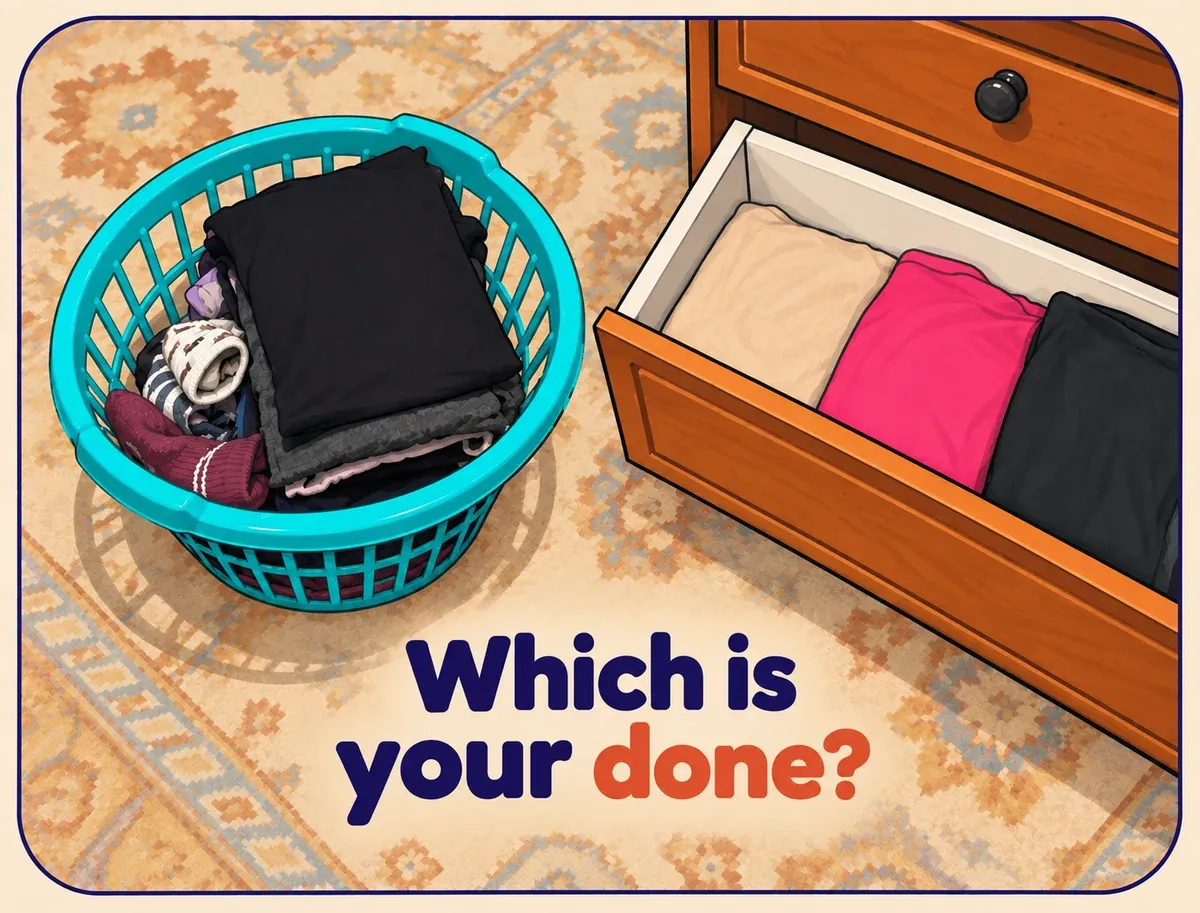
One of my favorite Connect cards from GamePlan says:
Find a task with a fuzzy “done.”
What counts as finished? Say it out loud.
Seems simple. Except “done” is one of those words that feels completely obvious to you, but certainly not to everyone else. And this becomes even more apparent when you talk about tasks you do all the time at home.
When I say, “I’ve got the dishes,” I mean: I will clean all the dishes in the sink, hand wash the ones that don’t fit in the dishwasher, and clean the sink when I’m finished. To me, that is doing the dishes. Obviously.
Except, apparently, it isn’t obvious.
Cue my partner. When he says, “I’ve got the dishes,” he means: I will do the dishes until the dishwasher is full. (He detests doing the dishes.) Food at the bottom of the sink? It might stay there. Dishes that don’t fit? They stay there too. Just to show how personal and defensible these actions are, my partner (not me!) added the underlined text to the final blog.
THIS DRIVES ME BONKERS. Absolutely insane! Because in MY head, there are still dishes in the sink. But in his head, he did a great job doing the dishes.
That’s a fuzzy done. And the tricky part is that neither of us thinks we have a definition of doing the dishes. That is… until someone doesn’t do it “right”.
Fuzzy dones aren’t just about what gets done. They can also be about when it gets done. My husband, for example, replaces the toilet paper immediately after the roll is empty. Me? I register that the roll is empty. But I file that information somewhere in the back of my brain and vow to grab another one next time, even if there’s one sitting right on top of the toilet.
Again, underlined text is from my partner. This addition is only (slightly) funny because it nicely illustrates how differences in “my right” and “his right” can very quickly snowball into an argument.
And it’s really easy to miss. I mean, I had no idea this irritated him until I wrote this blog. In fact, I am pretty sure I blamed him for forgetting a few times. (Oops.)
Tiny science break.
Shared mental models are a great concept from teamwork research. Basically, when people work together, they each carry around an internal picture of how the work works: what needs to happen, how it should happen, and who is responsible for what. The more those pictures line up, the easier it is to coordinate. And it matters because teams with more similar mental models perform better and with less conflict. [1]
Household research finds the same dynamic hiding inside chores. In one study, researcher Emily Christopher asked 25 couples to work through who “mostly” handled 25 household tasks. Every couple disagreed at least once. And 23 of the 25 couples disagreed at least four times. [2]
And cleaning was particularly interesting because couples didn’t just disagree about who cleaned. They sometimes disagreed about what counted as doing a “proper” job in the first place. [2] In other words: fuzzy dones are lurking everywhere at home.
And apparently, we are not alone.
A few fun numbers, because my husband and I are clearly not the only couple who can look at the exact same sink and think:
Looks good. Dishes in the dishwasher.
and
HOW ARE WE LIVING LIKE THIS?
Caveat: except for the study above, these are survey and polling data, not peer-reviewed research. But they are a pretty good reminder that the thing you think is “obvious” may not be obvious at all.
| Fuzzy done | What people said | Translation |
|---|---|---|
| When and how should chores happen? | In one survey of partnered Americans, 53% of chore-doers said they disagreed about when chores should happen, 50% about how they should be done, and 48% about who should do them. [3] | Basically, a whole lot of fuzzy dones. |
| Was that actually clean? | 61% said they had cleaned something again after their partner had already cleaned it. [3] | Which is an extraordinary amount of “Thank you. I will now redo that.” |
| Dishes: Do you rinse first? | 71% of Americans said dishes should be rinsed before going in the dishwasher. 16% said they shouldn’t. [4] | Same appliance. Different universe |
| Dishes: Do the pots count? | When asked about large pots and pans, 40% said they should be washed by hand, 33% said they belong on the bottom rack of the dishwasher, and 12% said it doesn’t matter. [5] | “I did the dishes.” vs. “THERE IS LITERALLY A POT RIGHT THERE.” |
| Dishes: Is there a right way to load it? | 34% of Americans who share a dishwasher said they had disagreed with someone about how it should be loaded or used. [6] | Apparently, dishwasher loading is a belief system. |
| Toilet paper: When does replacing it happen? | 70% said they always replace the roll immediately after using the last piece. [7] | The rest of us are living dangerously. |
| Toilet paper: And then which way does it go? | 57% prefer the paper to come over the roll, 14% prefer under, and 24% have no preference. [7] | Even after we agree to replace it, we still haven’t agreed on “done.” |
And to show how embedded mental models of home tasks can be. My husband added this statement (with the citation!) when he read the final blog: “The 71% is wrong, by the way, as evidence shows.” [Consumer Reports]
So what do you do with a fuzzy done?
Is doing the dishes loading the dishwasher or leaving an empty sink?
Is laundry done when it is clean? Dry? Folded? Put away?
Is taking out the trash done when the bag leaves the can or when a new liner is in?
Is dinner done when the food hits the table or when the kitchen is reset?
These sound tiny. Until you live with them every day. And then they become very personal. Think of a task where you have been disproportionately irritated by the way your partner completed it. Anything where you have thought: There’s still more to do.
Maybe your partner simply didn’t do a good job. Or… maybe they did an absolutely amazing job on their done. Just not yours.
That is why we Connect. Find the fuzzy done. Say out loud what finished means.
Not because your definition is right and theirs is wrong. But because the definitions inside our heads are invisible until we put them into words. And give each other a little grace. Mental models are hard to change because they don’t feel like opinions. They feel obvious… even when they make absolutely no sense to the person standing next to you.
References
1. Lim, B.-C., & Klein, K. J. (2006). “Team mental models and team performance: A field study of the effects of team mental model similarity and accuracy.” Journal of Organizational Behavior, 27(4), 403–418. DOI: 10.1002/job.387.
2. Christopher, E. (2021). “Capturing Conflicting Accounts of Domestic Labour: The Household Portrait as a Methodology.” Sociological Research Online, 26(3), 451–468. DOI: 10.1177/1360780420951804.
3. Yelp / OnePoll (2019). Modern Love and Household Responsibilities Survey. Survey of 2,000 Americans living with a partner.
4. YouGov (2021). “Do you think people should rinse dishes before putting them in the dishwasher?” U.S. Daily Question, November 5, 2021. Survey of 5,382 U.S. adults.
5. YouGov (2024). “Do you think that large pots and pans should typically be washed…?” U.S. Daily Question, September 23, 2024. Survey of 38,100 U.S. adults.
6. YouGov (2024). “Have you ever disagreed with someone you share a dishwasher with about how the dishwasher should be loaded or used?” U.S. Daily Question, September 23, 2024. Survey of 38,100 U.S. adults.
7. Bialik, C., & Orth, T. / YouGov (2023). “Toilet Talk: Polling Americans’ Potty Preferences.” February 15, 2023. Based on a series of YouGov polls of U.S. adults.
8. And my favorite: Consumer Reports, “Don’t Bother Pre-Rinsing Your Dishes.”