
Ok, let’s talk about always.
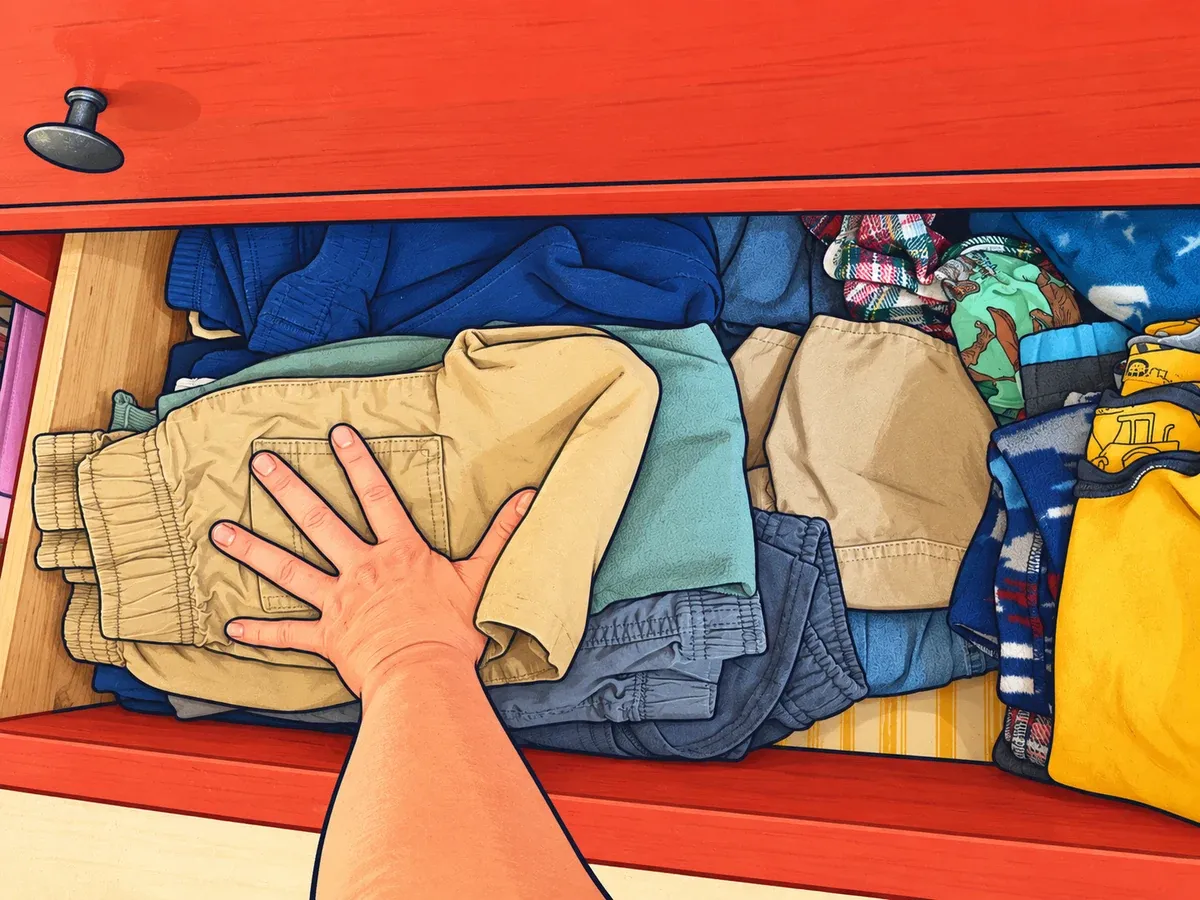
A few weekends ago, I was putting away the kids’ clothes. Somewhere around the third shirt, my
brain started with: I always put up the kids’ clothes. I put up my clothes and four kids’ clothes, and my partner puts up his. That is 5 to 1.
Which was immediately followed by the related observation: …Do I have winter boots for everyone?
And my personal favorite: …Why do I always have to remember everything?!
There is no clean slate at home. It’s pretty dirty, and it’s not very flattering. Everything gets remembered. And when I am tired or overwhelmed, remembered in the extreme.
The particularly annoying thing is that I know better. My partner actually does put up the kids’ clothes. I know this. I saw it happen this weekend. As a scientist who loves data, I find this version of data analysis deeply inconvenient. Because if we were actually keeping score (which, to be clear, might be a terrible idea), the data would not support always.
And yet there I was. Rage shoving my son’s shirt in his drawer. Feeling always.
The shirt had somehow invited the winter boots, every other load of laundry, and the entire mental load of our household into the room. That poor shirt was carrying a lot. This tiny moment had picked up years of history.
And that’s what I mean by a smudge. History stuck to the current moment. A laundry argument from three years ago. The five times I asked about the thing. The period when work was insane. The task I somehow became responsible for and I’m not entirely sure how. After you’ve been teammates with someone for a decade, there’s a lot of history available to join today’s argument.
Tiny science break.
Work teams have a version of this problem too. Researchers Tony Simons and Randall Peterson studied 70 top-management teams and looked at two kinds of conflict:
Task conflict: We disagree about the work.
Relationship conflict: We have a problem with each other.
Those sound pretty different. Except they can get tangled together. (Sounds a bit like home?) And one thing that affected whether they got tangled was trust within the team. In lower-trust teams, disagreement about the work was more likely to get interpreted as something interpersonal.
Basically: You disagree with my idea.
can turn into: You have a problem with me.
A second study makes this even more interesting. Simon Tidd, Heather McIntyre, and Raymond Friedman studied 141 people working in managerial, professional, and administrative jobs. When the work itself offered a plausible explanation for conflict (like unclear roles) people were less likely to read the disagreement as personal. And that pattern was even stronger when trust was high.
Basically: Maybe we’re disagreeing because the plan is unclear.
instead of: You’re doing this to me.
Which feels very familiar. Because when something goes wrong at home, there is usually more than one possible story.
The plan is unclear. Or you don’t care.
We thought different people owned the task. Or you dumped this one on me.
Same problem. Very different story. And that’s the problem with always. It can take what is happening right now and quietly attach everything that came before it. Sometimes that history is useful. Sometimes it’s wildly unfair. Sometimes the same annoying thing really has happened seventeen times.
A smudge doesn’t mean: Everything is fine. The basket of clothes in front of me is real. Maybe one person really is doing more. Maybe the plan really does need to change. But: I always put up the clothes is a much bigger statement than: I am putting up the clothes right now. And from inside the moment, that bigger statement doesn’t feel like a smudge. It feels like a fact. Which brings me to one of the cards we wrote for GamePlan:
Find one task... that you always do.
Because always can mean two very different things. Maybe I don’t actually always put up the clothes. It just feels spectacularly true right now. Or maybe: I really do always put up the clothes. Also useful to know.
So the next time always or never shows up in my head, before I treat it as a fact, I’m going to ask: Is this actually true? And if it is: Is this actually our plan?
Probably a good thing for me to check before I pick a fight about the laundry. (Oops.)
Sources: Simons, T. L., & Peterson, R. S. (2000). Task conflict and relationship conflict in top management teams: The pivotal role of intragroup trust. Journal of Applied Psychology, 85(1), 102–111. https://doi.org/10.1037/0021-9010.85.1.102
Tidd, S. T., McIntyre, H. H., & Friedman, R. A. (2004). The importance of role ambiguity and trust in conflict perception: Unpacking the task conflict to relationship conflict linkage. International Journal of Conflict Management, 15(4), 364–380. https://doi.org/10.1108/eb022918