
Let’s talk about activation energy and getting things done. There’s a term in chemistry called activation energy. It’s the energy needed to get a reaction going. Lower the activation energy, and the reaction can happen faster.
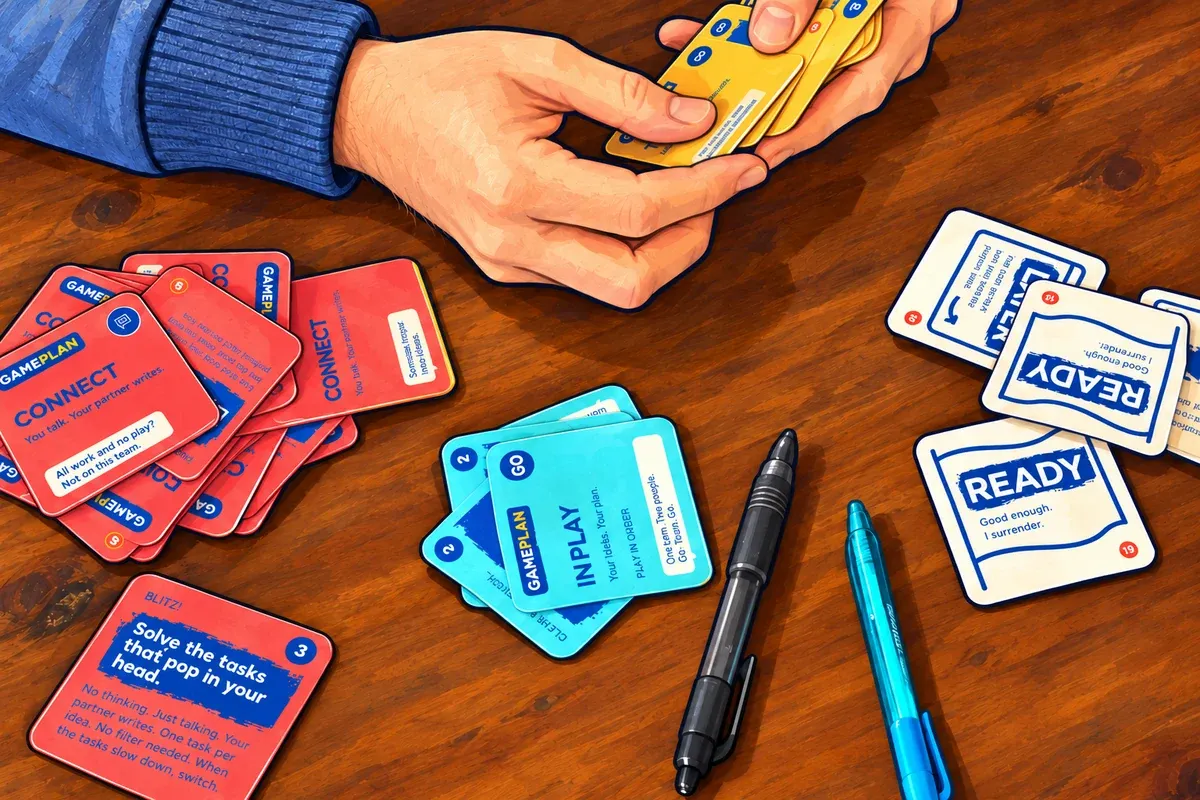
This weekend, my partner and I played GamePlan. And for the first time, I filmed him setting up the cards.
And… it took forever!
I’d changed the cards to a small square shape, which I love. He fumbled them, struggled to find the starting cards, and then had to put them in order.
Ugh. I’m five months and 37+ versions deep into this design. I’ve put a lot of work into these cards. Apparently, I’d left a lot of work for the person using them, too.
There’s a pretty big leap from loving what you’ve made to throwing it in the trash. And the toughest part is that the leap starts off invisible. A quick retrospective on everything that had to go through my head before I could actually get to work:
- Wow, this is taking so long.
- (This one is embarrassing.) Is his coffee cup nearby? This is a classic IMBY move: It Must Be You.
- Wait a sec, maybe there's a problem?
- Gut check.
- Yup, funny feeling.
- Something is off.
- I don’t like waiting this long.
- Hold on. Why am I actually waiting this long?
Finally, my thinking brain starts firing, and I start looking and listening to what's in front of me. In my defense, it’s hard to recognize that what you built is not as great as you thought it was a minute ago. The faster I get to problem recognition, the faster I get to problem solving. That’s the first part of the barrier I’m calling activation energy. And I want to keep it low. So low that I can act quickly, learn, and repeat.
Quick science break
Researchers Louis and Sutton describe “switching cognitive gears”: moving from automatic responses to active thinking. Their argument is that recognizing when we need to make that shift matters. And for me, the quicker I get there, the quicker I can do something about the problem.
There’s a practical connection in design research, too. Nathan Crilly interviewed 13 professional designers. They described how testing prototypes helped them see where their ideas weren’t working, loosen their grip on them, and consider alternatives. In my case, that meant looking a little less closely for his coffee cup and a little more closely at my cards.
Now, back to my card problem.
My partner and I don’t have time to fumble cards. And I don’t want to make setting up a planning game another task we have to get through. So, as much as I loved version 37+, I needed to change it. The whole point of Thymely’s first game, GamePlan, is to lower the activation energy needed to plan together. To make it easier to sit down, talk about hard things, and work out what to do.
So, about an hour after we played, while I was in the middle of sorting laundry, I scrapped version 37+. (Ouch!) I went radical and redesigned the starting cards as a game board to go with the Connect and Trade decks.
The setup is now simpler and gets to playing and planning sooner.
And more importantly, I like it. I like it a lot.
References
- OpenStax. Chemistry 2e. Section 12.5, Collision Theory.
- Louis, M. R., & Sutton, R. I. (1991). Switching cognitive gears: From habits of mind to active thinking. Human Relations, 44(1), 55–76. https://doi.org/10.1177/001872679104400104
- Crilly, N. (2015). Fixation and creativity in concept development: The attitudes and practices of expert designers. Design Studies, 38, 54–91. https://doi.org/10.1016/j.destud.2015.01.002