
So why a game?
That’s a good question. And truthfully, Thymely started as an app. Think Cozi with AI: schedules, tasks, lists, all the stuff a family needs to keep track of.
But the more I thought about it, the more I realized that keeping track of everything at home wasn’t really the problem I wanted to solve. What I really wanted was to feel like I was on the same team with my partner. Slaying kid drop-off in three different locations at the same time. Tag-teaming dinner and bedtime like an Olympic relay team. Knowing somebody else has the thing I was about to remember for the seventeenth time.
Lots of these things feel small. Pack the bag. Make the appointment. Order the shoes. Figure out dinner. But collectively? It’s work. And a whole lot of it.
Home is a pretty wild workplace.
Let’s switch over to work. Think of one of those teams you loved being a part of. I’ve had teams like that. We talk. We hand things off. We ask for help. And work gives us structures that make it easier to coordinate. There’s a project plan. A stand-up. A whiteboard. A meeting whose entire purpose is:
Here is the work.
Here is where we are.
Here is what happens next.
Who has what?
At home, my partner and I can spend practically the entire week in each other’s orbit and still never have that moment. Instead, coordination happens while someone is cutting strawberries, looking for a missing shoe, and shouting upstairs that we needed to leave three minutes ago.
Being near someone is not the same thing as coordinating with them.
And this isn’t just any team relationship. This is also your partner. Maybe your co-parent. The person who remembers the last four times this exact thing happened. There is enough potential tension built into that relationship already.
So how does this complex, overworked team get it all done without making every conversation about everything that has (or hasn’t) happened before?
That question is what eventually moved Thymely off the screen and onto the table.
So I started looking at what helps teams get on the same page when the work gets complicated.
Tiny science break.
Quick caveat: the research here isn’t about couples managing a household. It’s about teams doing shared tasks. But it points to something really useful.
In experiments with collaborating pairs, a shared visual space made it easier for people to keep track of the current state of a task and communicate about it more efficiently [1].
One term researchers use for this kind of shared understanding is a shared mental model. Basically, the people on a team have a similar picture in their heads of what’s going on—what the work is, how the pieces fit together, and what needs to happen next.
And that shared picture really matters.
In a study of teams, stronger shared mental models were associated with less conflict within the team and, through the study’s model, with better performance and satisfaction [2]. It wasn’t an experiment, so it can’t tell us that shared understanding caused those outcomes. But the relationship is interesting and it lines up with what I’ve seen.
Put it on the table
So here’s how that plays out in a game.
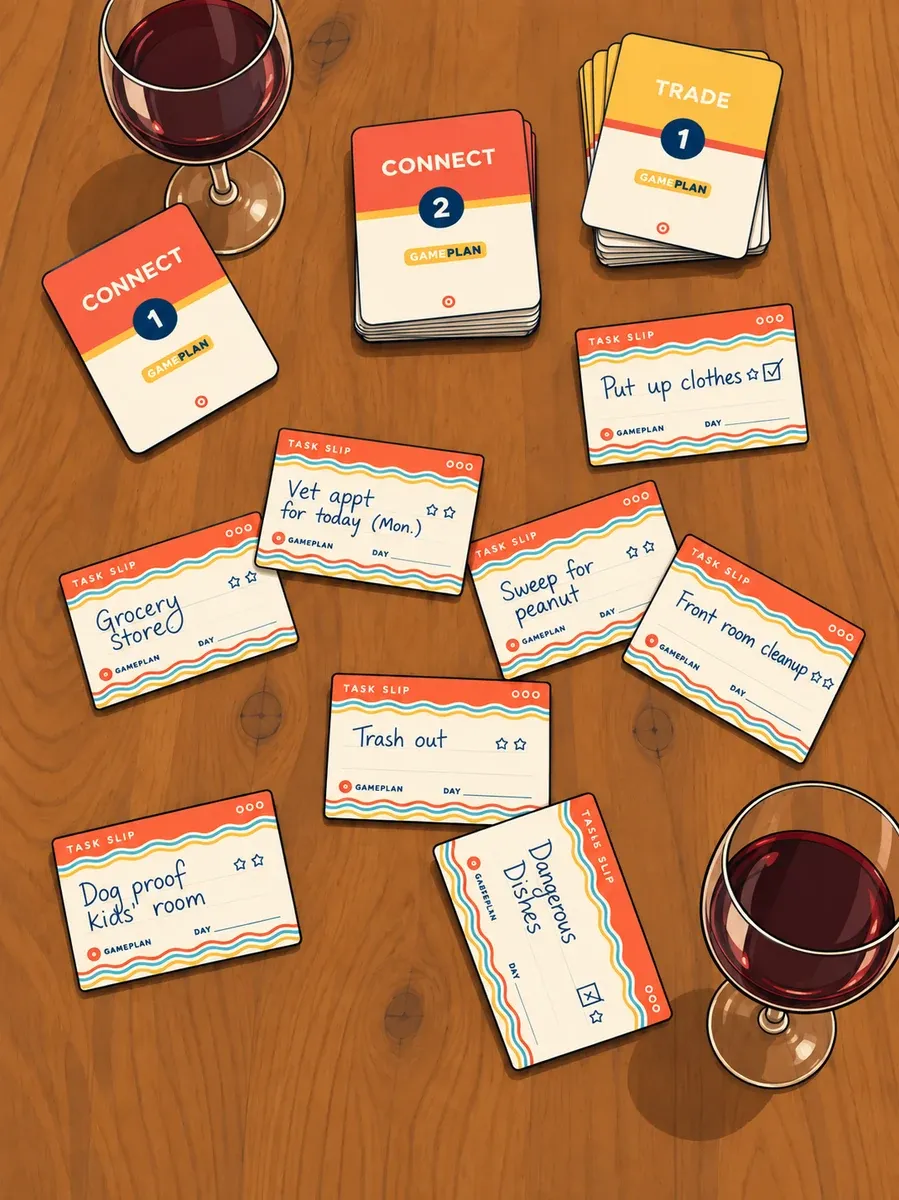
GamePlan is pretty simple: get the work out of your heads and onto the table, one task at a time. Each task gets its own slip, so you can see the work, move it around, and figure out what happens next. The appointment. The groceries. The birthday present. The thing in the basement no one wants to talk about.
All the little things scattered across two people’s heads start appearing on the table. And now we’re looking at the same thing. We can move the work around. Talk about what has to happen first. What can wait. What’s missing. Who has what. We can literally pick up a task and hand it to another person.
Instead of trying to reconcile two different pictures in our heads, we build one together. And that changes the conversation. Put 15 household tasks on the kitchen table and watch what happens.
What about this one?
Wait. This has to happen first.
Can this wait?
Very quickly, the conversation gets more concrete: There are twelve things on this table and six of them don’t have an owner.
So why a game?
Because I wanted to get on the same page without bringing a team meeting into my kitchen. My partner and I already have too much to do. And the last thing I wanted was another system or app to maintain.
I wanted something we might actually want to do. Something useful, but also fun. That’s what the game gives us. The work comes out of our heads and onto the table. We can see how much there is. We can figure out what matters. We can decide what happens next.
And maybe most importantly, the conversation can shift from: You aren’t doing enough.
to: This is too much work. What are we going to do about it?
The goal was never really to organize the cards. It was to help us feel like we were on the same team.
Research behind this post
- Gergle, D., Kraut, R. E., & Fussell, S. R. (2004). Language Efficiency and Visual Technology: Minimizing Collaborative Effort with Visual Information. Journal of Language and Social Psychology, 23(4), 491–517. In an experiment with collaborating pairs, an immediately updated shared visual space reduced adjusted mean puzzle-completion time. The researchers also found that shared visual information helped collaborators maintain awareness of the state of the task and communicate about it more efficiently. DOI: 10.1177/0261927X04269589.
- Santos, C. M., Uitdewilligen, S., & Passos, A. M. (2015). Why Is Your Team More Creative Than Mine? The Influence of Shared Mental Models on Intra-group Conflict, Team Creativity and Effectiveness. Creativity and Innovation Management, 24(4), 645–658. The researchers followed teams during a management simulation and collected data at three points in time. Stronger shared mental models were associated with lower intragroup conflict, better team performance and satisfaction. Because this was not an experiment in which teams were assigned to have stronger or weaker shared mental models, the findings show an association rather than proving that shared understanding caused the reduction in conflict. DOI: 10.1111/caim.12129.